
The Forgotten Golden Age
One of the most persistent misconceptions surrounding Indian football is that the country has always occupied the margins of the international game. History tells a rather different story. During the 1950s and early 1960s, India stood among Asia’s leading football nations. Under the legendary coach Syed Abdul Rahim, often regarded as the father of modern Indian football, the national team developed a distinctive style built on technical ability, intelligent passing and tactical discipline. India won gold medals at the 1951 and 1962 Asian Games, reached the semi-finals of the 1956 Melbourne Olympics, and consistently challenged many of Asia’s strongest teams. These were not isolated victories born of fortune but evidence that India possessed both footballing talent and capable leadership at a time when much of Asia was still constructing its sporting identity.
The tragedy is not that this generation eventually declined—every successful football nation experiences cyclical rises and falls—but that India failed to institutionalise its success. Countries that establish themselves as football powers invariably transform periods of achievement into permanent structures. Winning teams inspire investment in academies, coaching education, school competitions and domestic leagues. Success becomes the catalyst for institutional reform rather than the culmination of it. India, however, largely treated its achievements as historical milestones instead of strategic opportunities. When Abdul Rahim passed away in 1963, there existed no robust framework capable of sustaining the philosophy he had created. The system had become dependent upon an extraordinary individual rather than strong institutions. As the coach disappeared, so too did much of the progress.

The contrast with Japan could hardly be more revealing. During the same era, Japan remained an unremarkable football nation with little international pedigree. Yet by the early 1990s, recognising football’s growing global importance, Japanese administrators launched one of the most ambitious sporting development programmes in modern history. The creation of the J.League in 1993 was never intended merely to establish a professional competition. It formed part of a comprehensive hundred-year vision linking grassroots participation, school football, coaching education, community clubs and professional academies into a single developmental pathway. Success was not expected immediately. Administrators understood that footballing cultures cannot be manufactured overnight. Three decades later, Japan regularly qualifies for World Cups, exports players to Europe’s elite leagues and has become one of Asia’s benchmark football nations. The difference between India and Japan was not inherent talent. It was strategic patience.

The Convenient Myth of Cricket
Few explanations have achieved greater acceptance than the belief that cricket is responsible for football’s underdevelopment. At first glance the argument appears persuasive. Cricket dominates television ratings, sponsorship revenues, newspaper coverage and public imagination. The Indian Premier League has become one of the world’s richest sporting competitions, while cricketing heroes enjoy cultural status unmatched by athletes in almost any other discipline. Football, by comparison, appears condemned to operate in cricket’s shadow.
Yet this narrative collapses under comparative analysis. Australia remains one of cricket’s traditional powers while consistently qualifying for FIFA World Cups. England simultaneously sustains the world’s richest football league and one of the strongest cricketing ecosystems ever assembled. South Africa, New Zealand and even Bangladesh demonstrate that nations are capable of supporting multiple elite sporting cultures when governance structures are sufficiently effective. Sport is rarely a zero-sum competition in which the success of one discipline inevitably causes the failure of another. Rather, successful sporting nations tend to develop institutions capable of expanding participation across multiple sports simultaneously.
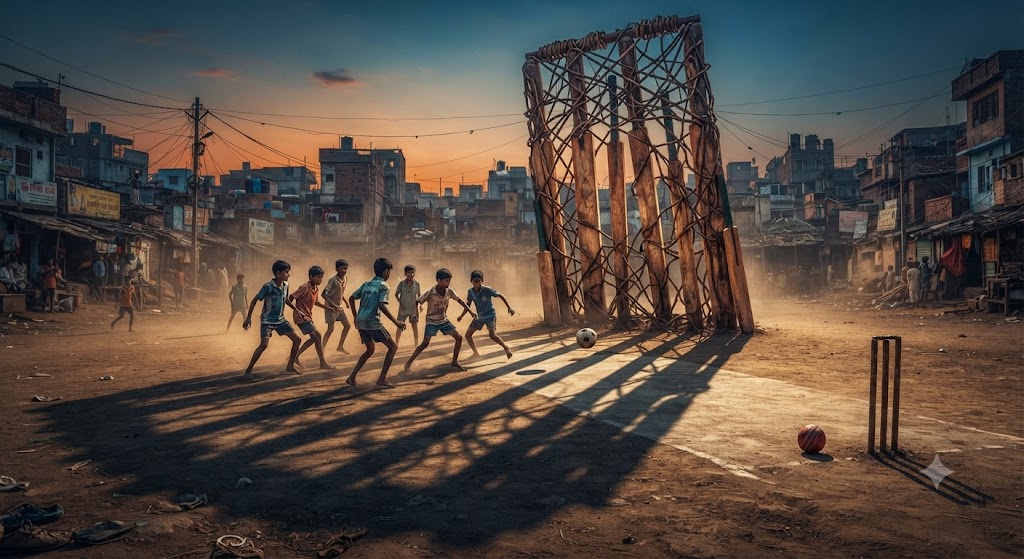
Indeed, the rise of cricket in India should perhaps be viewed not as football’s obstacle but as evidence of what competent administration can achieve. Over several decades, the Board of Control for Cricket in India transformed cricket from a popular pastime into one of the world’s most sophisticated sporting industries. It professionalised domestic competitions, secured lucrative broadcasting agreements, cultivated commercial partnerships and reinvested resources into infrastructure and player development. While debates continue regarding aspects of cricket governance, its strategic direction has remained remarkably consistent. Football never benefited from comparable institutional continuity. Administrative disputes, shifting leadership, inconsistent league structures and fragmented grassroots initiatives repeatedly undermined long-term planning. Cricket did not defeat football. Football largely defeated itself.
Perhaps the most revealing evidence lies not within India but beyond it. Football has flourished in countries where it competes directly with rugby, basketball, baseball and cricket for athletes, spectators and investment. The United States now exports elite footballers to Europe’s biggest clubs despite American football, baseball and basketball commanding vastly larger domestic audiences. Rugby has never prevented France or New Zealand from producing exceptional footballers. Multiple sporting cultures can coexist. The deciding factor is not popularity but institutional competence.
Football’s Invisible Infrastructure
The popular imagination often associates football development with iconic stadiums, glamorous professional leagues or high-profile international signings. These are the visible symbols of footballing success, but they are rarely its cause. The true foundations of elite football remain largely invisible to the public. They exist in community pitches, licensed youth coaches, school competitions, regional academies and structured developmental pathways that begin when children are barely old enough to tie their own boots. By the time a seventeen-year-old debuts for Barcelona, Bayern Munich or Sporting Lisbon, the overwhelming majority of his development has already occurred. Professional football merely reveals the finished product.
Successful football nations therefore resemble manufacturing ecosystems more than entertainment industries. Germany’s reforms following the disappointment of Euro 2000 required every professional club to establish accredited youth academies. Belgium fundamentally redesigned coaching education after recognising weaknesses in player development. Spain standardised technical instruction across age groups, ensuring children from vastly different regions learned compatible footballing principles. These reforms rarely attracted newspaper headlines. Their results only became visible a decade later when a generation of technically superior players emerged.
India has often attempted to reverse this process. Rather than strengthening grassroots development before expecting international success, considerable attention has focused on professional leagues, foreign coaches and senior national team performance. These initiatives undoubtedly possess value, but they cannot compensate for weaknesses lower down the developmental pyramid. Thousands of talented Indian children undoubtedly begin playing football each year. Far fewer receive systematic coaching. Fewer still experience high-quality competition on a weekly basis. By late adolescence, many abandon football altogether because educational obligations, financial pressures or limited career prospects interrupt their progress. Talent is discovered. It is simply not retained.
This phenomenon is often referred to by sports economists as the “missing middle.” Grassroots participation may exist, and professional football may exist, but the developmental bridge connecting the two remains incomplete. Countries such as Croatia, Portugal and the Netherlands minimise this attrition through highly organised academy systems. Every promising player understands precisely what progression looks like from local club to professional football. India continues to rely far more heavily on individual determination than institutional design. That is an extraordinarily inefficient method of producing elite athletes.
The Indian Super League and the Illusion of Progress
When the Indian Super League (ISL) was launched in 2014, it promised nothing less than a revolution. Backed by corporate investment, international broadcasters and a roster of globally recognised players approaching the twilight of their careers, the league appeared to represent the beginning of Indian football’s professional era. Stadiums were fuller than they had been for decades, television production rivalled Europe’s top competitions, and for the first time football occupied mainstream conversations outside its traditional strongholds. International stars such as Alessandro Del Piero, Robert Pires, Diego Forlán, Nicolas Anelka and Roberto Carlos lent the league a degree of credibility that Indian football had rarely enjoyed. For investors, broadcasters and sponsors, the ISL was proof that football possessed commercial potential in one of the world’s largest consumer markets.

Commercially, the league can scarcely be described as a failure. Attendances improved dramatically during its early years, television audiences expanded, private capital entered a sport that had long struggled for investment, and clubs began constructing modern training facilities and professional backroom operations. The league also succeeded in introducing higher standards of sports science, nutrition, analytics and marketing. In many respects, the ISL modernised the business of Indian football.
Yet football history repeatedly demonstrates that successful leagues do not automatically create successful national teams. The assumption that professionalisation inevitably produces international competitiveness confuses cause with effect. Strong domestic leagues are not valuable merely because they entertain supporters; they are valuable because they function as production lines for elite footballers. The Bundesliga, Eredivisie, J.League and Croatian First Football League all serve this dual purpose. Their commercial success is closely linked to their ability to develop domestic players who eventually strengthen national teams or move abroad to more competitive environments. Without this developmental function, a league risks becoming little more than an entertainment product.
The Indian Super League has struggled to resolve this contradiction. Clubs understandably operate under commercial pressures that reward immediate success. Foreign players, often more experienced and tactically refined than their domestic counterparts, provide the quickest route to competitive results. Coaches, whose employment depends upon short-term performance, naturally prioritise reliable professionals over inexperienced academy graduates. Owners seek trophies, broadcasters seek compelling matches and supporters demand victories. None of these incentives are irrational. Yet collectively they create an environment in which long-term player development becomes secondary to short-term competitiveness.
This is not a uniquely Indian problem. Major League Soccer in the United States faced similar criticism during its first two decades, relying heavily on ageing international stars while producing relatively few elite American footballers. The difference is that American clubs gradually restructured incentives around academy investment, introducing homegrown player rules, substantial youth funding and pathways linking professional clubs to local communities. Today, American players routinely transfer to Europe’s strongest leagues before their twenty-first birthday. Christian Pulisic, Weston McKennie, Yunus Musah and Gio Reyna represent products of a system that consciously shifted its priorities from attracting attention to producing talent. India has begun taking similar steps, but the transformation remains incomplete.
Perhaps the greatest limitation of the ISL has been its inability to generate a sufficiently demanding competitive environment for young Indian players. Elite footballers improve not merely through coaching but through repetition against opponents of comparable or greater quality. Spanish academy players often participate in forty to fifty competitive matches annually. Young footballers in Germany, Portugal and France experience structured league systems that expose them to progressively higher standards as they mature. India’s football calendar, by contrast, has historically been fragmented. Opportunities for sustained, meaningful competition have remained inconsistent across age groups and regions. A player who trains diligently but competes infrequently develops far more slowly than one exposed to constant tactical and technical challenges.
This issue becomes even more significant when viewed through the lens of global football economics. Europe’s leading clubs no longer simply scout established professionals; they identify promising teenagers long before they reach senior football. Jude Bellingham left Birmingham City at seventeen. Endrick signed for Real Madrid before his nineteenth birthday. Lamine Yamal became a Barcelona regular while still a schoolboy. Modern football increasingly rewards nations capable of accelerating player development during adolescence. India continues to produce talented youngsters, but too few accumulate the volume and intensity of competition necessary to reach international standards before those crucial developmental windows begin to close.
The Indian Super League therefore illustrates one of football’s central lessons: infrastructure is necessary but insufficient. Stadiums matter. Television audiences matter. Corporate investment matters. Yet these visible indicators of progress cannot substitute for the less glamorous work of producing footballers. A nation does not become competitive because it builds professional clubs. It becomes competitive because those clubs become educational institutions as much as sporting organisations. Until every ISL academy is regarded as strategically important as the senior first team, Indian football will continue to modernise commercially faster than it develops competitively.
The Coaching Crisis
If football has a hidden currency, it is coaching. Players may decide matches, but coaches shape generations. The quality of a nation’s football education depends less upon the manager standing on the touchline during international tournaments than upon the thousands of youth coaches working on community pitches every evening. It is here, often far from television cameras and professional stadiums, that future footballers first learn how to receive the ball under pressure, interpret space, anticipate movement and make decisions instinctively rather than consciously. By the time a player reaches professional football, many of these habits have become deeply ingrained. Elite coaches refine them; they rarely create them from nothing.
This reality explains why countries that transformed their football fortunes invariably began by reforming coaching rather than competitions. Germany’s response to the disappointment of Euro 2000 was not merely to establish new academies but to standardise coaching education across the country. Belgium introduced a unified coaching philosophy emphasising technical development from the youngest age groups. Spain ensured that possession, spatial awareness and intelligent movement became common principles taught regardless of region or club. These nations recognised that football identity is transmitted not through slogans or mission statements but through thousands of coaches teaching similar principles over many years.
India’s coaching landscape remains considerably more fragmented. Outstanding coaches undoubtedly exist, particularly within established footballing regions such as Goa, West Bengal, Kerala and the North-East. However, access to high-quality coaching varies enormously depending upon geography, economic circumstances and institutional support. Many talented children spend formative years under volunteers or part-time coaches with limited access to modern training methodologies. Others receive coaching focused primarily on physical conditioning or winning youth tournaments rather than long-term technical development. Such approaches are understandable within resource constraints, but they often prioritise immediate success over future excellence.
This imbalance becomes particularly evident when comparing coaching density across successful football nations. Croatia, despite its small population, maintains an extensive network of licensed coaches relative to the number of registered players. Japan invested heavily in expanding coaching qualifications following the establishment of the J.League, recognising that every additional qualified youth coach represented an investment in future national teams. Even Morocco’s remarkable emergence as a global football force can be traced partly to systematic improvements in coaching education alongside investments in elite academies. Football development, in each case, began with educators rather than superstars.
There is also a cultural dimension to coaching that deserves greater attention. In many successful football nations, youth coaches are evaluated less on trophies than on player progression. A youth team losing matches while producing technically gifted footballers may still be considered successful if players continue advancing through the system. India has too often measured youth football through conventional competitive outcomes. Coaches facing pressure to win school tournaments or academy leagues frequently adopt conservative tactics designed to maximise immediate results rather than encourage creativity, risk-taking and technical experimentation. The consequence is a generation of players conditioned to avoid mistakes instead of learning from them.
The challenge therefore extends beyond increasing the number of licensed coaches. It requires redefining what coaching success means. Producing one international footballer contributes more to national development than winning ten under-14 tournaments. Nations that consistently export players understand this distinction instinctively. They evaluate academies by graduates rather than medals. Until Indian football adopts a similar philosophy, coaching will remain an underutilised resource rather than the engine of long-term transformation.
The Missing Culture of Competition
One of the least appreciated drivers of football development is neither infrastructure nor coaching, but competition itself. Great footballers are not simply trained; they are tested. Every meaningful match forces players to solve tactical problems under pressure, adapt to unfamiliar opponents and make decisions in fractions of a second. Training develops technique, but competition develops intelligence. The world’s strongest football systems therefore ensure that promising players experience hundreds of demanding matches before reaching adulthood.
In Europe and South America, elite youth football resembles an educational curriculum. Each age group introduces progressively greater tactical complexity, physical intensity and psychological pressure. Clubs compete regularly throughout long seasons, while regional and national tournaments expose players to unfamiliar styles and higher standards. Defeat is not feared because it becomes part of the developmental process. Every difficult opponent accelerates learning.
India’s competitive ecosystem has historically lacked this consistency. Many promising youngsters train diligently for weeks before playing relatively few meaningful matches. Regional disparities remain considerable, with some states possessing vibrant football cultures while others struggle to organise regular competitions. School football, private academies, state associations and professional clubs often operate parallel systems rather than integrated pathways. Instead of a continuous ladder leading towards elite football, young players frequently encounter disconnected stages requiring them to navigate institutional uncertainty as much as athletic development.

The consequences become visible at senior level. Indian players often display technical quality and enthusiasm but struggle when confronted with the relentless tactical speed demanded by international football. This is not necessarily because they lack ability. It is because they have encountered fewer environments requiring them to think and execute under sustained pressure. Football intelligence develops through accumulated experience. Every additional competitive match expands a player’s catalogue of tactical solutions.
Countries such as the Netherlands have long embraced the principle that development should be measured by exposure rather than protection. Young players are deliberately challenged against older, stronger and more technically accomplished opponents. Mistakes are viewed not as failures but as essential components of learning. India has often taken the opposite approach, shielding talented players from excessive difficulty or restricting opportunities through fragmented competition structures. The result is that many players arrive at senior football having mastered isolated technical skills but lacking the competitive instincts that emerge only through repeated exposure to demanding matches.
If coaching forms football’s classroom, competition provides its examination. Nations that consistently produce elite footballers ensure that examinations occur every weekend. India has too often excelled at organising lessons while neglecting the tests that transform potential into performance.
A Choice, Not a Destiny
It is tempting to describe India as football’s “sleeping giant,” a phrase that has been repeated so often it has become almost meaningless. Sleeping implies inevitability—that awakening is simply a matter of time. History suggests otherwise. There are no sleeping giants in football, only nations that choose to build institutions and those that do not. Population guarantees nothing. Economic growth guarantees nothing. Passion, commercial value and television audiences guarantee nothing. Croatia did not reach World Cup finals because it possessed more people than India. Japan did not become Asia’s benchmark because football was its most popular sport. Morocco did not rewrite African football history through chance alone. Each succeeded because it committed, often for decades, to building systems that outlived governments, administrators, coaches and generations of players. Their success was not accidental; it was institutional.
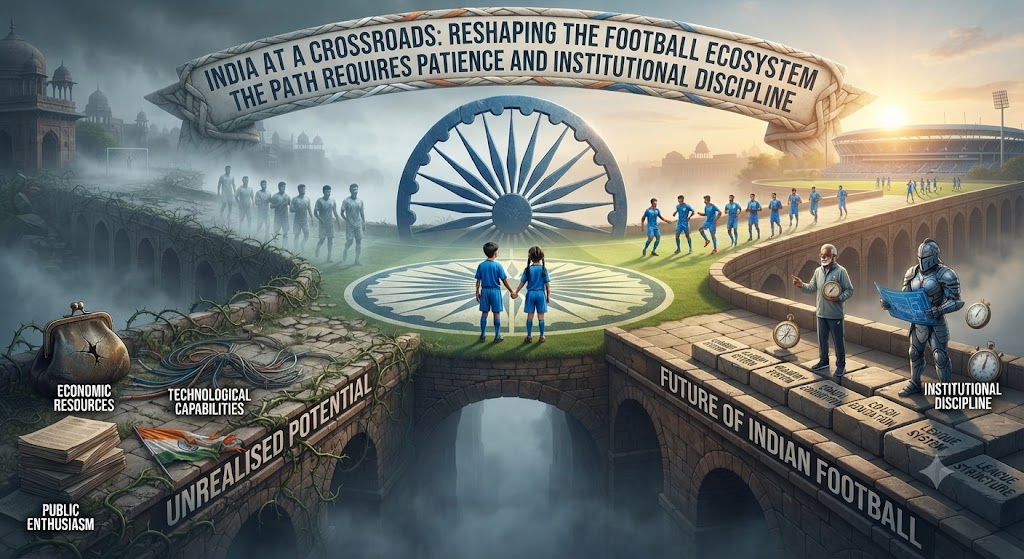
India now stands at a similar crossroads. For the first time in its history, it possesses the economic resources, technological capabilities, commercial interest and public enthusiasm to fundamentally reshape its football ecosystem. Yet these advantages will remain little more than unrealised potential unless they are matched by patience and institutional discipline. Football development cannot be measured by the launch of a new league, the appointment of a foreign coach or the hosting of a major tournament. It must be measured by whether a talented twelve-year-old in Imphal, Kozhikode, Kolkata or Goa can follow a clear, uninterrupted pathway to elite football regardless of background or geography. That requires investing less in spectacles and more in coaches, academies, school competitions and local clubs. It requires accepting that the true returns on today’s decisions may not be visible for fifteen or twenty years.
Perhaps the greatest misconception surrounding Indian football is that it is waiting for a golden generation. In reality, golden generations are rarely discovered—they are manufactured. They emerge when institutions become so effective that excellence ceases to be exceptional and instead becomes routine. The question facing Indian football, therefore, is not whether the country possesses enough talented children; with a population of over 1.4 billion, it almost certainly does. The question is whether it is finally prepared to build the machinery capable of finding them, educating them and allowing them to flourish. Until then, India will remain one of football’s largest audiences but one of its smallest competitors—a nation that consumes the world’s game with extraordinary passion while contributing remarkably little to its highest levels. If that changes, it will not be because India found more talent than everyone else. It will be because, at long last, it learned that football’s greatest victories are won long before kick-off.



 Additionally criticized for its authoritarian inclinations were Chavez’s government’s handling of political rivals and its control of the media. Despite these accusations, Chavez continued to have support from many Venezuelans who considered him as a champion of the underprivileged and a representation of the independence of Latin America. Nicolas Maduro, Chavez’s successor after his death in 2013, carried on many of his ideas, including the nationalization of important companies and the introduction of social programs.
 The initial adoption of cryptocurrency was slow, and it took several years for the concept to gain mainstream attention. The first step in the adoption of cryptocurrencies by the general public was the 2009 release of Bitcoin by an unidentified author or group of developers operating under the pseudonym Satoshi Nakamoto. At the time, early adopters and tech enthusiasts who were interested in Bitcoin’s potential as a decentralised and secure method of conducting transactions made up the majority of its user base. It took a while before the idea of cryptocurrencies caught the attention of the general public. In a few more years the Cyprus financial crisis, which made people lose faith in conventional banking systems, contributed to the rise in popularity of Bitcoin in 2013. Bitcoin provided a different method of carrying out transactions that was exempt from the restrictions and rules that traditional banking was. As a result, the value of Bitcoin significantly increased, drawing greater interest from investors and the media.
 However, when things seemed to go smoothly for cryptocurrencies, there was a sudden opposition against its validity and its use.The Reserve Bank of India (RBI), the country’s central bank, declared a ban on cryptocurrencies in 2018 and forbade banks and other financial institutions from doing business with cryptocurrency exchanges and traders. The action was taken to reduce the risks connected to cryptocurrencies, including money laundering, financing of terrorism, and other illicit acts. The RBI also voiced concerns about the bitcoin market’s lack of regulatory oversight and consumer protection. The Indian cryptocurrency community, however, vigorously opposed the prohibition, claiming that it was unnecessary and would inhibit innovation in the industry. The restriction was contested in court by a number of cryptocurrency exchanges, and in 2020 the Indian Supreme Court struck it down, ruling that it was unconstitutional.
  Many new schemes were introduced with the formation of this new government, including the Jan Dhan to Jan Suraksha, Pradhan Mantri Jan Dhan Yojana, Atal Pension Yojana, and many others. However, one scheme stands out above the rest: the Pradhan Mantri Mudra Yojana. This scheme was implemented in 2015, a year after the Modi government took office. The programme was designed to provide loans to micro and small businesses. The loans are given without any collateral and are intended to improve the beneficiaries’ livelihoods by creating job opportunities, promoting entrepreneurship, and improving beneficiaries’ livelihoods.


 MacroTopic